Clouds live a life. They breathe and engage. They take morning walks, shower at will, and stroll around for the rest of the day. They stop by us for a cup of tea, they sit next to us for lunch and stay with us till dusk. They are omnipresent. Clouds breathe as we breathe. They chitchat as we do. They have fun like we have.
Clouds live a life just as we live. I felt it the minute I landed in Manali – The land of clouds.
In Manali you wonder if the whole world, from abyss to zenith, is made up only of dragonesque mountains, wandering clouds and lovely water passes. You are engulfed in green and white.
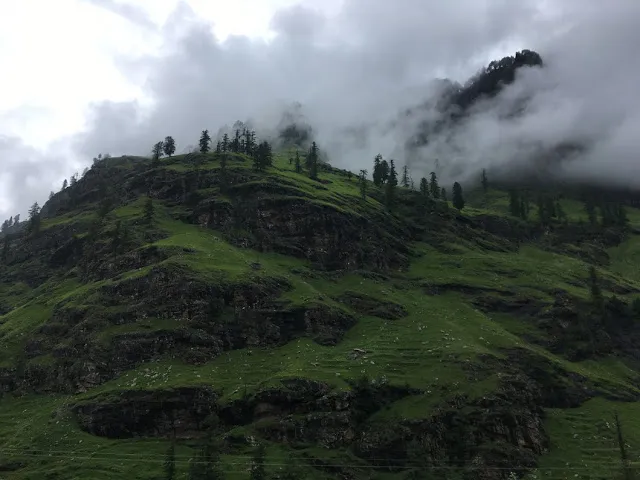
The Himalayas and Royal Enfields thud their way from Manali to Rohtang Pass. The route puts up a scenic canvas of enviable emotions. One is swallowed by nature, landing far inside its stomach.
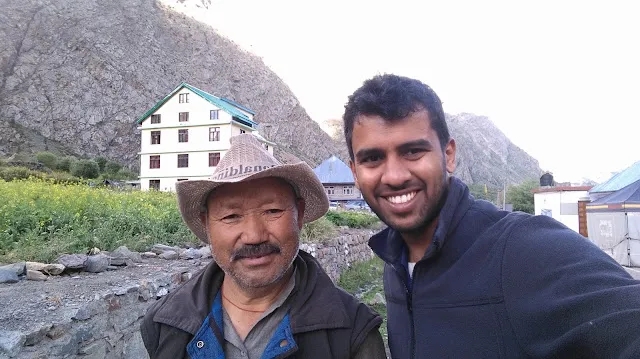
A day long ride from Manali takes us to a small village called Jispa. I realise how small the village is when the old man I happened to meet the next morning says to me that the only school they have at Jispa has a mere 10-15 children. When the snow starts falling, he says, the whole of Jispa moves to Manali and returns only once it stops.
So, during winter, Jispa is all white and deserted except for a herd of cattle!
Midway from Jispa to Sarchu, we stop for lunch – the only place in fact, throughout entire day’s route, to refresh and reenergize. The place is spacious enough for a short nap and the owner sweet enough for a chat, who proudly says - she along with a couple of her relatives set up the dhaba in two days’ time which is strong enough to stand the wind for a couple of months; that is when the season ends and she returns to Manali.
She doesn’t have change for Rs 20, so instead gives us toffees, and says, only a sweet lady offers toffees!
Diamox tablets are a handy ally to counter altitude sickness in this part of the world. As we reach Sarchu, which sits at 14,000 ft. high, we experience the scarcity of oxygen for the first time and reach out for diamox tablets. Measure your steps, warned our instructors. We had to. A few quick steps and we could easily count our breath. It thus turns out to be a measured evening at Sarchu.
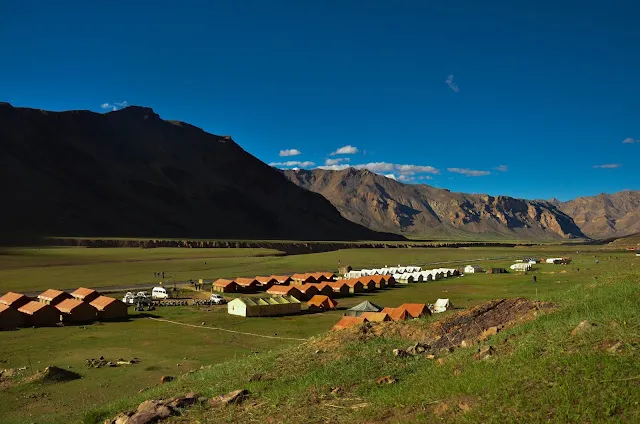
Luxurious, attached bathroom-tents are lined up in parallel. At one end, sat an old lady in saree, covering herself with a shawl whereas I was fully packed – mufflers, thermals, gloves and what not! Yet, I could sense my skin tear under the cold wind even as this lady sat pretty much unmoved. She had come with her son on a bank sponsored tour. She spoke Hindi very well in Bengali. With some time lag I could figure out her language. She spoke like a proud Bengali, holding on to her roots, unperturbed by the conditions.
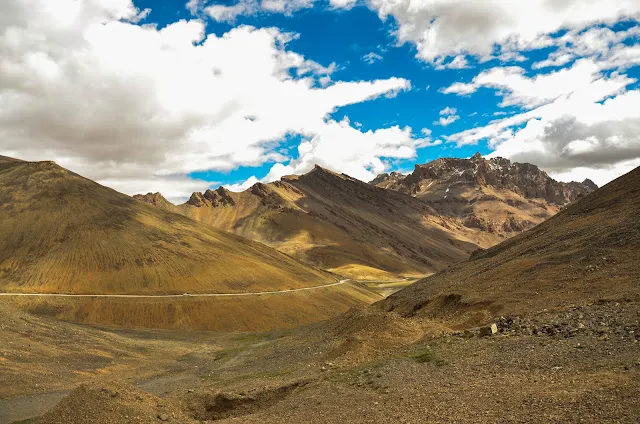
At 1000 ft. higher than Jispa, stands Pang. Even before we reach Pang, we realize it made no sense to take bath at Sarchu, for we were completely dust-bathed. The terrain is unforgiving. The road is not built but carved along the bare mountains. Humongous, deserted mountains they are. It is just amazing how humans have managed to find a way out in these mountains. Like a line drawn on a dry skin, roads stand along the mountains. They are lonely and bereft.
The Army general, whom we happened to meet at Pang, had a few concerning words over the nature of politics that is being played at various parts of India. He stood for one India which is too strong to be divided by caste, creed and ethnicity. His concerns were valid and his words encouraging.
We get going from Pang to Leh. The flat-wide roads come as a relief. The Taglang La ascent and descent make for a great ride, though at 17,000 ft. high one is not supposed to stay long and still breathe freely. As we come across these sparsely populated barren mountains, you wonder if the human habitation is altogether in a different world. Thanks to BRO (Border Roads Organization), for connecting the worlds.
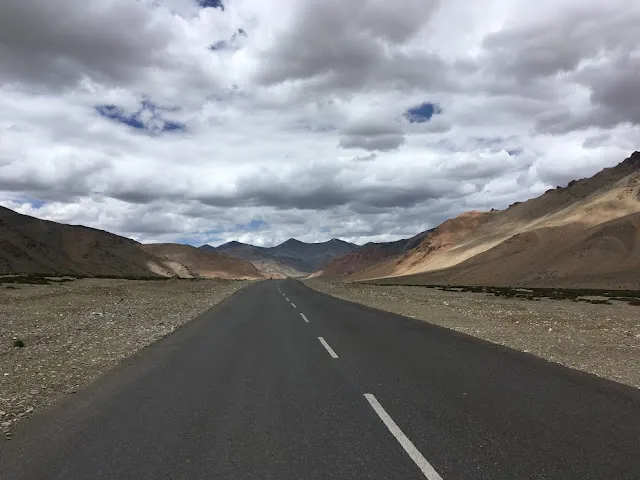
We reach Leh, and we breathe the air humans breathe. We see men, women, and children; we see shops, schools, Stupas and trees. We see cultivation and habitation, and get to smell the human life.
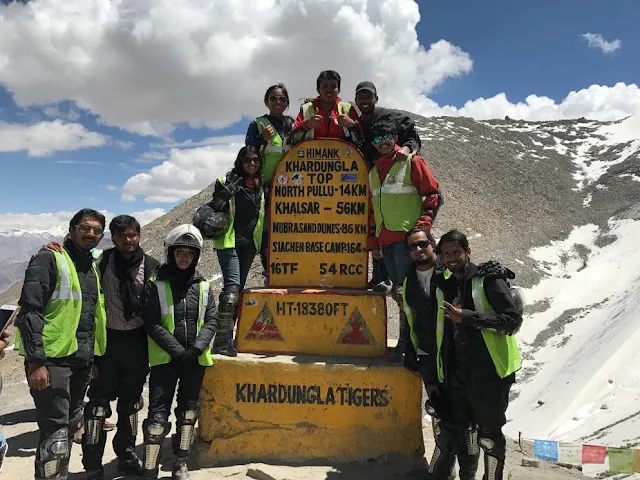
Next morning, we set path to Kardung La, the 2nd highest motor-able road in the world. Frequent landslides and snowfalls make it one of the most difficult terrains to ride. The terrain was hitting us hard. Yet, a sense of relief crawled into us as we saw some brave cyclists cycle their way up! Well, it takes something else to pedal here.
At Kardung La, we get the first touch of snow, the first feel of it. And yes, the ice is damn cold! I slide across it and my hands go numb for the next few minutes. Damn the ice; it hurts. Not for nothing that we grow cold when we die. It is cool and beautiful to stand afar and watch; it burns and eats into us as we step into it.
His eyes are compassionate; his smile is sympathetic. Beneath the mountains, he seems to live a life that is within his reach. His boundaries are defined. He runs a dhaba at Kardung along with his wife. Seasoned tourists fill his pockets, and at other times of the year he runs his farm. He innocently envies me when I say I work for a software firm. He can only stretch as far as the mountains but not beyond them, he says, as he calls himself uneducated. But to spread some happiness, to display a touch of humanity, education is not the mandate, I say. He agrees with a smile.
Then he speaks of his hope, his prayers, and his dream - his son. He has gone as far as Srinagar to study Engineering. He prays his son gets into a decent job. His wife joins him with the prayers. His life will, perhaps, remain sandwiched between the mountains. But his dreams, hopefully, one day can stretch beyond the mountains. I wish him as I leave. The picture of his eyes will remain with me.
Under the hot sun we ride from Kardung and reach Nubra by evening. Gazing at the stars, we spend the night at the Nubra valley – a region which has a heavily populated sky in stark contrast to its sparsely populated land. Far away from our homes we are now nearer to the stars.
We head back to Leh the next morning and park our bikes at our hotel for one last time. To Pangong, we were to travel by Tempo Traveler which, to be frank, did come as a relief. Our cab driver, Stanzin says, he takes this 150 odd Km treacherous route 20-25 times in about 3-4 months. To us, this was one among the many other things (including the aloo parathas) that we simply couldn’t easily digest in Ladakh.
However, delicious foods and luxurious tents serve us well for the rest of the night even as the air blows increasingly cold.
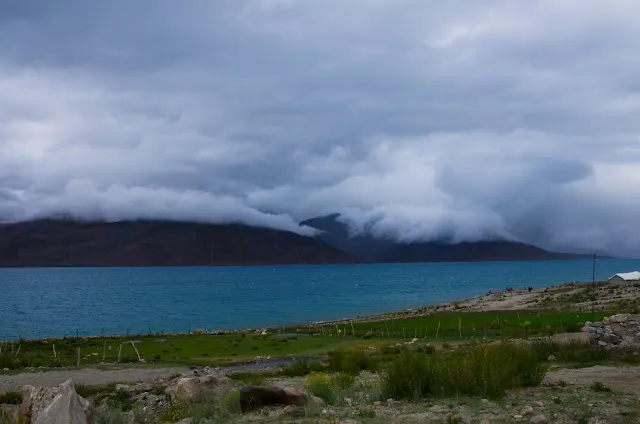
At Pangong, we wake up to dark clouds and chilly wind. We take small but measured steps through the cold air towards the shore of the beautiful Pangong Lake - shared contentiously by India and China - now about to be engulfed by the dark clouds from across the horizon. The lake, though, lays out a sense of tranquility. However, the recent skirmishes across the border confirm, the air is hot and cold at the same time!
The region of Ladakh is not just about beautiful landscapes, lonely plateaus and rough terrains, it is also a picture of relentless human determination to strive and succeed. Ladakh is also associated with a great amount of pride and sacrifice. I could sense it when our local cab driver, Tashi, spelt ‘Leh-Ladaaakh’. He didn’t just spell it but meant it.
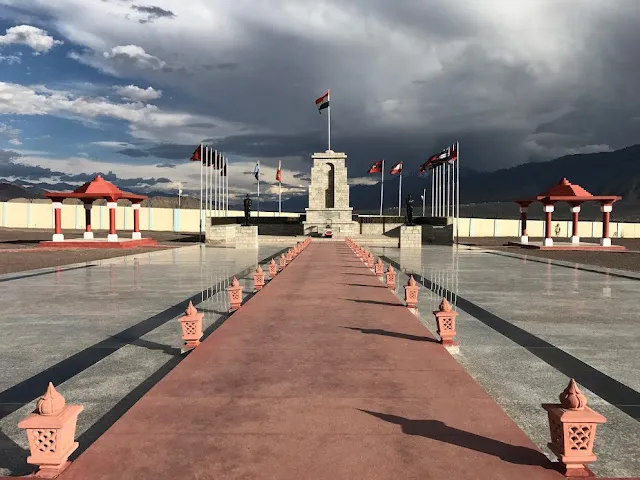
Ladakh has been a ground to many battles - the Indo-Sino war, the Siachen war, the Kargil war. Many soldiers have bled and sacrificed their lives. Wars have been fought in extreme conditions to say the least. The War memorial at Leh is a great guide to what transpired in Ladakh during the wars. Pride and patriotism creep into your blood even as your eyes slowly turn wet. The memorial leaves you with a heavy heart and a lot of disturbing questions.
Soldiers take a huge amount of pride in what they do. Their hardship and sacrifices scale above all that we common citizens do for our nation; it is not just another job. But what makes our soldiers fight in these inhuman conditions? What makes them live their lives on these treacherous mountains?
It is nothing but humanity’s failure which makes them stay here and defend the land.
Siachen was made so that no human could ever lay his foot there. To counter it, human ego was made. No wonder ego triumphed. Only a human can envision a battle at sub -40 Celsius at a height of 18,000 ft., where oxygen level drops to half of that of normal. Soldiers die every day at Siachen to live another day, and it is a human disaster.
As you stand in front of the war memorial, open to the vast sky, with the Indian Flag flying high, you cannot but think it’s all in the name of the Flag. All the sacrifices seem justified. Yet, questions are disturbing and reasons, however strong and convincing they are, fall short of justifying an innocent heart.
But let me end on a brighter note. So, let me end with an old man with a young heart.
He, from Switzerland, had been cycling all over Ladakh for over a month now. We meet him on our way back to Leh from Pangong. He was all smiles and exhibited little sign of tiredness whatsoever. He was in fact embracing Ladakh.
His eyes lit up in glee and smile broadened to new horizons as he exclaimed - “Ladakh is sensaaaational…just beaaaautiful”.
The whole of Ladakh and the old man’s gleeful eyes lure me for a second coming.
Thanks to International Youth Club for the memorable ride.